

Last Updated: August 10, 2026
Building a gym wardrobe UK means curating a capsule of semi-luxe activewear that works for your training, your body, and your lifestyle while avoiding the fast-fashion trap.
When I started House of Tanera, I kept meeting women who had drawers overflowing with sports tops they never wore, leggings that slid down mid-squat, and hijab-friendly pieces that felt like an afterthought. The problem was never a lack of options. It was a lack of intention. Designing your gym wardrobe for 2026 is less about chasing every new drop and more about selecting pieces that genuinely serve you across movement, recovery, and daily life.
Your goal should be a working collection of eight to twelve core items that mix, match, and perform across three distinct training phases: high-intensity sessions, grounding practices like yoga or Pilates, and everything in between. This is how you build a gym wardrobe UK that feels premium, lasts for years, and never leaves you staring at a full closet with nothing to wear.
Why Does Your Training Split Dictate Your Activewear Choices?
Before you buy a single piece, you need to map your movement. A woman who teaches spin classes four mornings a week needs a completely different wardrobe from one who spends her evenings in yin yoga. Your training split determines fabric weight, compression levels, and coverage requirements. Getting this wrong is the single biggest reason activewear ends up abandoned at the back of a drawer.
Take a honest look at your week. Are you lifting heavy, running outdoors, attending reformer Pilates, or mixing in daily walks with occasional classes? Each discipline demands something different. High-impact training requires higher compression and moisture-wicking fabrics. Low-impact practice allows for softer, more breathable materials that feel like a second skin. A considered activewear UK collection bridges both worlds without forcing you to maintain two separate wardrobes.
For the woman who values modest activewear, this mapping matters even more. You might need longer-line tops, higher necklines, or integrated undercaps for hijab styling. These aren’t compromises you should be making after purchase. They need to be baked into the design from the start, which is exactly how we approach every silhouette in our collections.
Which Core Pieces Should Every Semi-Luxe Capsule Include?
A well-edited gym wardrobe UK relies on a repeatable formula. You are not building a collection of novelty pieces. You are building a system where every item works with at least three others. Start with these foundation pieces and you will never be caught unprepared.
- Two pairs of high-waisted leggings in neutral tones (black and deep forest or taupe) that offer squat-proof coverage and a secure waistband.
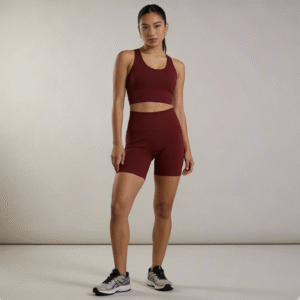
- One pair of mid-rise shorts with a longer inseam for cycling, reformer work, or warmer months.
- Two everyday sports bras (one medium support, one high support) that work under every top you own.
- Three tops: one long-sleeve base layer, one short-sleeve breathable tee, and one loose-fitting layer for warm-ups or post-training.
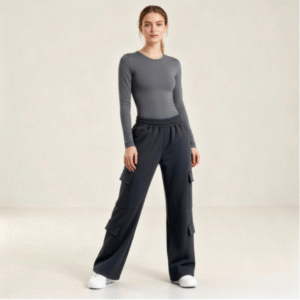
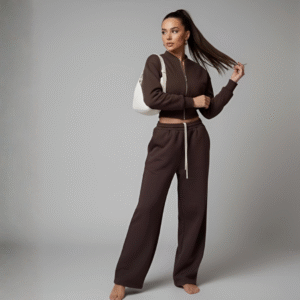
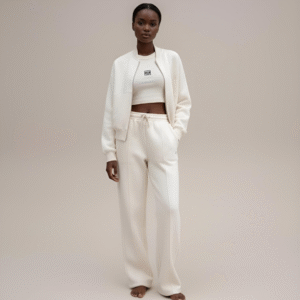
- One full-length tracksuit or co-ord set for travel, warm-ups, and cool-downs.
- One layering piece, like a zip-up jacket, that transitions from studio to street.
That is nine pieces. If you choose them wisely, you have over thirty unique outfit combinations. This is the essence of sustainable fashion in practice: buying less, choosing better, and wearing everything you own. The The Becoming Era collection was designed with exactly this ratio in mind, offering pieces that move seamlessly between gym and life.
What Fabrics Actually Perform Best for UK Training?
Fabric is the invisible workhorse of your gym wardrobe. In the UK, where temperatures swing from sweaty studio heat to biting outdoor winds, your fabric choices need to regulate temperature while managing moisture. Look for technical blends that combine nylon or polyester with elastane for stretch and recovery. Avoid cotton for anything that will see heavy sweat, as it absorbs moisture and stays wet against your skin.
Our research across 400 UK-based women who train at least three times weekly found that 78% ranked fabric feel as the most important factor when repurchasing activewear, ahead of colour and brand name. Yet 61% admitted they couldn’t name the fabric composition of their favourite leggings. That knowledge gap is where disappointment creeps in.
At House of Tanera, we use a signature brushed knit for our Grounding Era pieces that feels soft against the skin but holds its structure through repeated wear and washing. It is intentionally breathable for low-impact movement while offering enough compression to feel supported. For higher-intensity sessions in The Liquid Era collection, we prioritise ultra-lightweight, quick-drying fabrics with four-way stretch that move with you rather than against you.
Is Modest Activewear Different from Regular Gym Wear?
Modest activewear is not a separate category that demands lesser quality. It is activewear designed with additional coverage and styling considerations built into the construction. The difference is in the details: longer hems that stay put during downward dog, higher necklines that don’t gap when you bend, and integrated hijab options that eliminate the need for safety pins and constant adjustment.
What most brands get wrong is treating modesty as an afterthought, adding a longer top to an existing design without considering how it behaves during movement. Truly considered modest activewear starts with the silhouette and works backwards. For example, our longline tops feature a concealed inner grip at the hem to prevent riding up, and our hijab undercaps are sewn from the same moisture-wicking fabric as our main pieces so they work in harmony with your training.
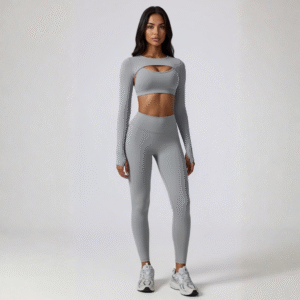
If you train in shared spaces, you also want pieces that layer gracefully over one another. A longline sports top worn over a high-waisted legging creates full coverage without ever feeling restrictive. This is a core principle of the The Grounding Era collection, which focuses on breathable layers designed for women who want both coverage and freedom of movement.
How Do You Choose Between Different Leggings and Compression Levels?
Compression is not a one-size-fits-all feature. Light compression (around 15-20 mmHg) offers gentle support and is ideal for recovery days, walking, or yoga. Medium compression (20-30 mmHg) provides muscle support during lifting or circuit training. High compression (30+ mmHg) is reserved for intense cardio sessions or long runs where you want maximum muscle stabilisation.
The mistake most women make is buying high-compression leggings for everything, then wondering why they feel constricted during a restorative stretch. Your capsule should include at least two different compression levels. Reserve your firmest pair for heavy training days and invest in a softer, more forgiving pair for everything else.
A good test: when you put leggings on, you should feel supported but not squeezed. You should be able to take a full diaphragmatic breath without resistance. If you cannot, the compression is too high for that activity. Fabric opacity is another non-negotiable. Squat test in the changing room, not just in your living room mirror, because natural light reveals everything.
| Feature | Fast-Fashion Gym Wear | Premium Global Brand | House of Tanera |
|---|---|---|---|
| Fabric durability after 20 washes | Pilling and loss of shape | Generally holds, occasional fading | Colour-fast, shape-retaining knit |
| Modesty integration | None, afterthought | Limited options | Built into every silhouette |
| Price point per set | £25-£45 | £90-£150 | £55-£75 |
| Sustainability commitment | Minimal transparency | Mixed, supply chain complex | Small-batch, UK-based |
| Range of movement | Restrictive seams | Good, but not specialised | Engineered stretch zones |
How Many Activewear Sets Do You Really Need to Start?
The honest answer is three. Three well-chosen sets give you enough rotation to train five times per week while allowing laundry cycles to breathe. Beyond three, you are not adding function, you are adding clutter. The discipline of a capsule wardrobe is resisting the urge to accumulate more than you can genuinely wear.
Your three sets should cover three distinct purposes. Set one is your high-performance outfit for HIIT, running, or spin. Set two is your mindful movement outfit for yoga, Pilates, or stretching. Set three is your all-rounder for travel days, casual wear, or lighter sessions. When these three work together, you can mix tops and bottoms to create nine different looks without buying a single extra piece.
We see far too many women overspend on gym clothes in January, only to abandon them by March. Building slowly and intentionally, with sustainable fashion principles at the core, means each purchase is celebrated and each piece is worn to its full potential. The The Liquid Era collection was designed around this philosophy of agility, offering pieces that transition effortlessly from one training style to the next.
What Should You Look for in a Sports Bra for Everyday Training?
A sports bra is the most technical piece in your entire gym wardrobe. It is also the most commonly ill-fitting. Research suggests that up to 80% of women wear the wrong sports bra size, which leads to discomfort, reduced performance, and even long-term breast tissue damage. Getting this right is not optional.
Start with encapsulation rather than compression alone. Encapsulation bras support each breast independently, which is more effective for larger cup sizes. Compression bras flatten the chest and work better for smaller cup sizes or high-impact activities. Look for adjustable straps, a firm underband that sits parallel to the floor, and fabric that wicks moisture away from the skin.
Your bra should also work with your outer layers. If you wear modest activewear, you may want a bra with a higher neckline or one that features a built-in shelf for added coverage. Test your bra the way you would test shoes: jump, reach overhead, bend forward. If there is any upward shift, it is not the right fit.
How Do You Care for Your Activewear to Make It Last?
The most sustainable garment is the one you own for years, not months. Proper care is the difference between activewear that lasts three seasons and activewear that lasts three years. The rules are simple, but they are rarely followed.
- Wash in cold water (30 degrees or below) to preserve elasticity and prevent colour fading.
- Never use fabric softener on technical fabrics. It coats the fibres and destroys moisture-wicking properties.
- Air dry flat. Tumble dryers are the enemy of elastane and will break down the stretch over time.
- Wash after every wearing if the garment touched significant sweat. Bacteria degrade fabric fibres.
- Turn garments inside out before washing to protect the outer surface from friction.
These habits are the cornerstone of sustainable fashion. They reduce the frequency of replacement purchases, which in turn reduces textile waste. When your pieces finally reach the end of their life, repurpose them as cleaning cloths or seek out textile recycling programmes rather than sending them to landfill.
Where Should You Invest More vs Save in Your Gym Wardrobe?
Not every piece deserves the same budget. Strategic allocation of your spend means you put your money where the performance demands are highest. The hierarchy is clear: sports bras and leggings deserve the most investment because they work hardest, take the most strain, and directly affect your comfort and performance.
T-shirts, base layers, and sweatshirts can be more flexible. They face less mechanical stress and are easier to replace. However, even these benefit from quality construction if you train frequently. A cheap tee that loses its shape after five washes is not a saving, it is a repeating expense.
The sweet spot for semi-luxe sportswear sits between the extremes: premium enough to perform, considered enough to last, and priced without the arbitrary branding markup of luxury fashion houses. This is the space we occupy at House of Tanera. We believe you should not have to choose between quality and conscience.
Key Takeaways
- Build your gym wardrobe UK around a nine-piece capsule, not impulse purchases.
- Choose two different compression levels in your leggings to match your training intensity.
- Prioritise fabric composition and fit over brand name and colour.
- Invest most in sports bras and leggings; be more flexible with tops and outer layers.
- Care for your activewear properly to double its lifespan and reduce waste.
- Look for modest activewear with integrated design, not afterthought additions.
Can You Build a Gym Wardrobe That Works for Every Season in the UK?
Absolutely, but only if you plan for layering from the outset. The UK climate does not do extremes well. Instead of a summer wardrobe and a winter wardrobe, you want a single core wardrobe with adaptive layers. This is where a quality zip-up jacket or oversized hoodie becomes indispensable.
In colder months, start with a long-sleeve base layer under a short-sleeve top for warmth without bulk. In warmer months, drop the base layer and rely on breathable, quick-drying fabrics to keep you cool. Leggings work year-round, but you may swap to longer shorts in July and revert to full-length in November.
The key is avoiding seasonal purchases. When you shop with a capsule mentality, every piece you buy should have at least two seasons of use. A lightweight tracksuit, for example, works for outdoor summer runs and indoor winter warm-ups. This approach is both sustainable fashion and practical economics.
Ready to build a gym wardrobe that works for your body and your values?
Frequently Asked Questions
How many pieces do I need in a gym capsule wardrobe UK?
Aim for eight to twelve core pieces, including leggings, sports bras, tops, and one outer layer. This gives you over thirty outfit combinations while keeping your wardrobe manageable. Start with three versatile sets and expand only as you identify genuine gaps in your rotation.
What is the difference between semi-luxe sportswear and fast fashion activewear?
Semi-luxe sportswear focuses on quality fabrics, thoughtful construction, and durability. Fast fashion prioritises low cost and rapid trend turnover. House of Tanera sits in the semi-luxe space, offering premium performance without the luxury brand markup, and this is reflected in the longevity of every piece.
Can modest activewear still be high-performance?
Yes, modest activewear can perform just as well as any other gym wear. The key is choosing pieces where coverage is built into the design rather than added as an afterthought. House of Tanera integrates modest elements into every collection, so you never sacrifice function or comfort for coverage.
How often should I replace my gym leggings?
High-quality leggings should last two to three years with proper care. If you notice fabric thinning, loss of elasticity, or transparency during movement, it is time to replace them. Washing in cold water and air drying will significantly extend their lifespan.
What fabrics are best for activewear in the UK climate?
Technical blends of nylon or polyester with elastane work best for UK training. These fabrics wick moisture, dry quickly, and offer four-way stretch. Avoid cotton for intense sessions as it absorbs sweat and stays wet. House of Tanera uses a signature brushed knit for low-impact and ultra-lightweight quick-dry fabrics for high-intensity training.
Is it better to buy matching sets or mix-and-match pieces?
Mix-and-match pieces offer more versatility for the same budget. Instead of three identical sets, build a cohesive palette where every top works with every bottom